
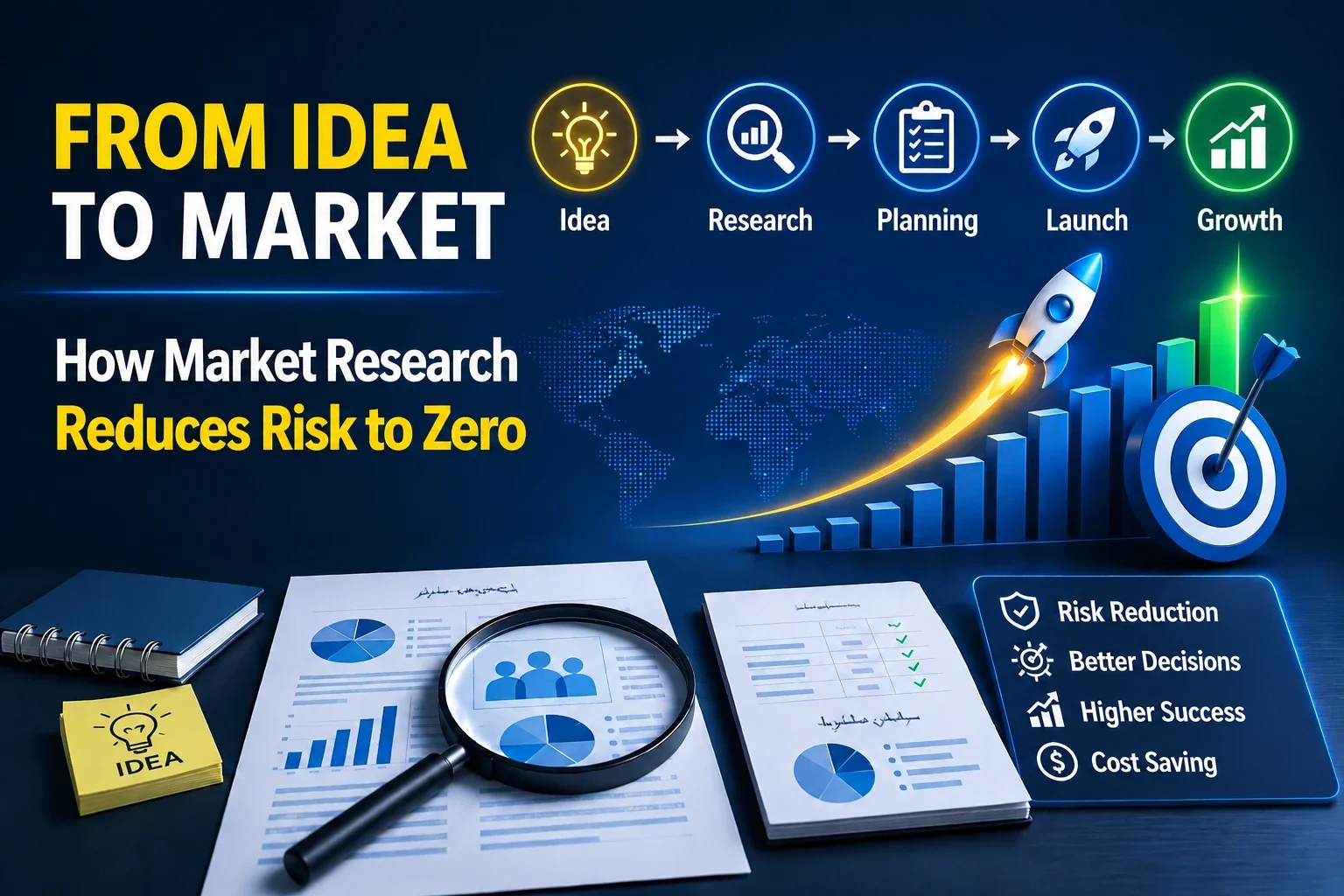
Many fascinating ideas that look brilliant on paper end up failing upon confronting market reality. The primary reason for this failure is the lack of Product-Market Fit. Market research is the bridge connecting your vision to reality.
What Is Market Research and Why Shouldn't You Rely Solely on Personal Intuition?
As a business consultant, I have repeatedly encountered entrepreneurs who are in love with their ideas, convinced that everyone needs their product. Yet the market has no emotions; the market responds solely to real needs.
Market research empowers you to test your hypotheses and make decisions grounded in real data before committing heavy financial and time investments.
Key Benefits of Market Research Before Launching
Conducting rigorous, field-based research delivers the following essential advantages:
- Drastic Reduction of Financial Risk: Preventing the production of an offering that has no buyers in the market.
- Deep Understanding of Consumer Behavior: Uncovering precisely what pain points, needs, and purchasing habits your target audience possesses.
- Identifying Market Gaps: Discovering untapped market segments overlooked by competitors (Blue Ocean).
- Determining an Optimal Pricing Strategy: Understanding exactly how much your target audience is willing to pay to resolve their problem.
Actionable Methods for Conducting Market Research and Competitor Analysis
You do not need massive corporate budgets to achieve this. With today's digital tools and a few proven techniques, you can access immensely valuable insights.
The most critical step on this journey is analyzing competitors and evaluating customer behavior across online platforms.
Tools and Steps for Conducting Market Research
Follow these strategic steps to kick off your research:
- Direct and Indirect Competitor Analysis: Examine their websites, pricing models, strengths and weaknesses, and customer reviews on social media.
- Leveraging Online Tools: Utilize Google Trends to analyze keyword search dynamics and online survey tools to collect direct feedback from your target audience.
- Developing a SWOT Matrix: Identifying Strengths, Weaknesses, Opportunities, and Threats for your own venture.
- Designing an MVP (Minimum Viable Product): Releasing a lean, cost-effective version of your product to the market to empirically validate buyer behavior prior to mass production.
Comments